
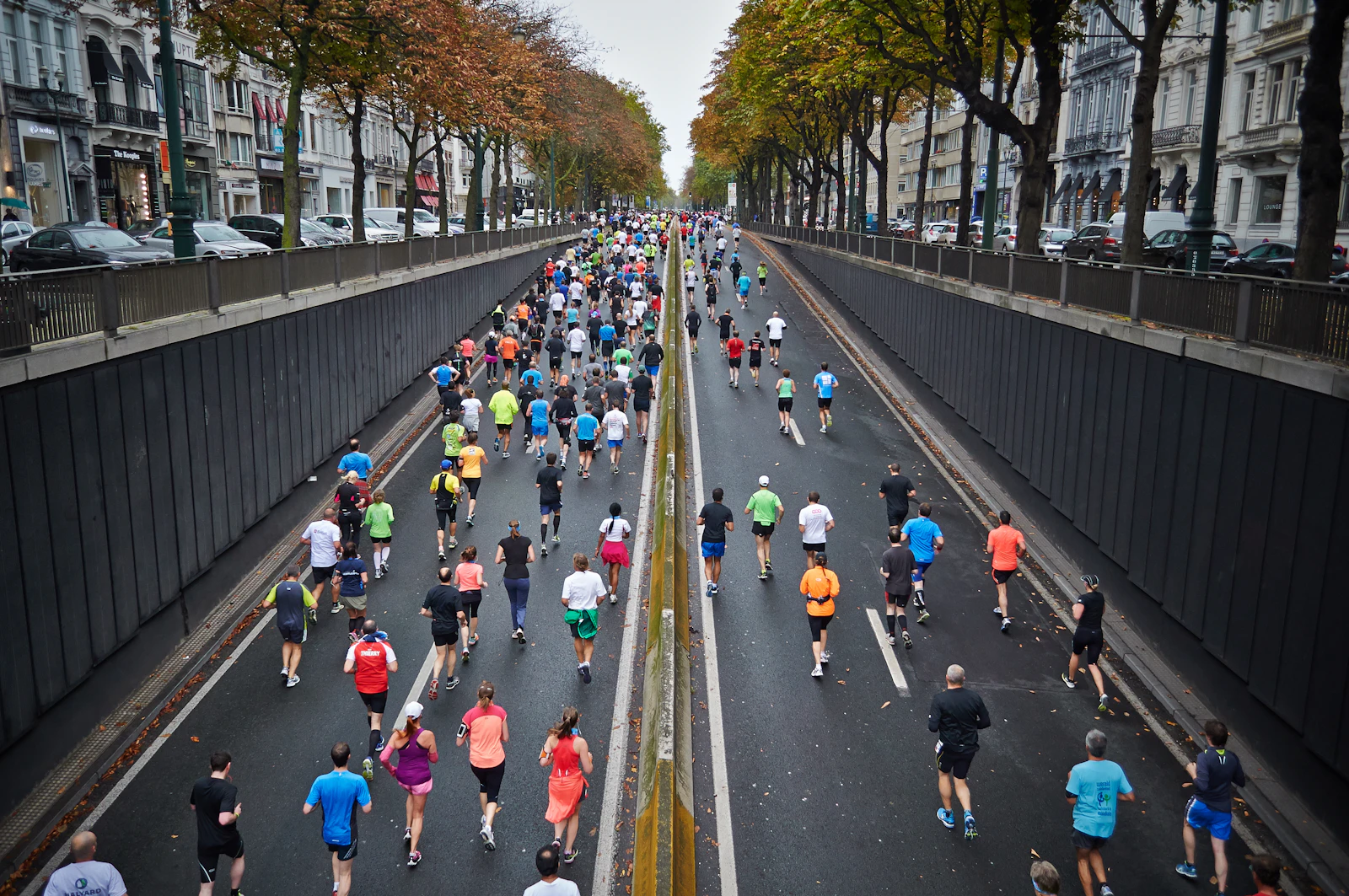
Not long ago, a “recreational runner” trained by feel. Today, across running, cycling and triathlon, the data points the same way: amateurs plan, measure, cross-train and recover the way professionals used to — and it is starting to show in the results.
You went out, ran until you were tired and hoped it added up to something on race day. Training plans came from magazines, and heart-rate zones were for people with coaches. That runner is getting harder to find.
More people, more ambition
The 2026 London Marathon ballot received 1,133,813 applications — a world record and 36% more than the year before. Strava’s 2025 Year in Sport report, built on data from more than 180 million users, found Gen Z marathon participation up 33% in a single year, while running clubs on the platform nearly quadrupled.
More people taking on long distances could easily mean slower races, and for a long time it did. RunRepeat’s analysis of 19.6 million marathon results found the average finish time drifting from 3:52 in 1986 to 4:32 in 2018, as the sport opened up to many more first-timers. Which makes the newer numbers surprising.
The clock is turning back
In 2025, RunRepeat analysed 10.5 million US marathon results — about 97% of all US finishes, elites excluded. The average finish time fell from 4:39 in 2019 to 4:34 in 2024, and every age group got faster. In the authors’ words, marathon runners as a whole are getting faster for the first time.
Europe shows the same. Strava data from the London Marathon put the median finish at 4:06:39 in 2023, down from 4:18:34 the year before. In 2024, 46% of Strava-tracked London finishers went under four hours and 9% under three. Shoes help — but they don’t explain everything. The training logs do.
What “training like a pro” looks like now
- Structured volume. Strava’s analysis of 2024 London Marathon finishers shows a textbook build: about 31 km a week four months out, around 45 km a week a month out with long runs near 32 km, then a deliberate taper to roughly 12 km in race week.
- Cross-training. 62% of those finishers did something other than running during their build, mostly cycling and strength work.
- Training together. Of runners who trained with others, 29% “hit the wall” in the last 10 km. Of those who trained alone, 45% did. The run club has become a performance tool.
- Data. In a study of 210 habitual runners, 47% regularly tracked heart rate variability — a recovery metric that lived in sports-science labs a decade ago.
- Coaching and plans. At the Western States 100, 47% of sub-24-hour finishers in 2023 had a coach. And Strava bought the training-plan app Runna in 2025 — a sign of how many everyday athletes want structure instead of guesswork.
Older, and still getting better
The most encouraging data comes from athletes who “should” be slowing down. Researchers studying 25 years of Ironman Hawaii results found that age-group triathletes over 40 significantly improved their swim, bike and run times between 1986 and 2010. A study of the New York City Marathon from 1980 to 2009 reached a similar conclusion: men over 64 and women over 44 kept getting faster.
Strava’s London data adds a telling detail: Gen X runners ran almost as fast as Gen Z, but logged 47% more training miles to do it. They are closing the gap with work.
The quiet professionalisation of the amateur
Put it together and you get today’s amateur endurance athlete: follows a plan, builds volume and tapers, lifts and cross-trains, tracks recovery, trains with a club. Nobody pays them and nobody films their long runs — yet many put sixteen weeks of early mornings, 30 km Sundays and careful recovery into a single race. That kind of commitment used to belong to people who did this for a living.
Why it matters
When you train like a pro, the finish line means something different. It is no longer one good day; it is the payoff for months of work that only you fully saw — the dark mornings, the intervals in the rain, the rest days you made yourself take.
Professionals have their trophies and photos on the wall. Amateurs mostly have a medal in a drawer and a GPS file buried in an app. Maybe the last part of training like a pro is treating what you achieved as worth remembering.
Sources
- RunRepeat — The State of US Marathons 2025
- RunRepeat — The State of Running 2019
- Strava: social training and London Marathon finishes (Endurance Business)
- Runners clocking faster London Marathon times (T3)
- Strava London Marathon data on older runners (Wareable)
- Strava Year in Sport 2025 (Endurance Sportswire)
- London Marathon 2026 ballot record (ITV)
- Lepers, Rüst, Stapley, Knechtle — 25 years of Hawaii Ironman racing
- Older athletes and performance limits in marathon running (NYC 1980–2009)
- Prevalence of HRV monitoring among habitual runners
- The trail and ultra coaching industry (iRunFar)
- Strava to acquire Runna (Endurance Business)